
The Thinking We Keep
We are still asking what artificial intelligence is. The more useful question is what it is already doing to how we think.

You know that thing where your mind sees something; something pretty, a topic, an idea, and just latches on to it like velcro to fur? A Twitter friend of mine wrote something a couple of days ago, and it has been top of mind. We do not know what intelligence is, he wrote, we do not know what consciousness is, and we are building machines that imitate both while understanding neither.
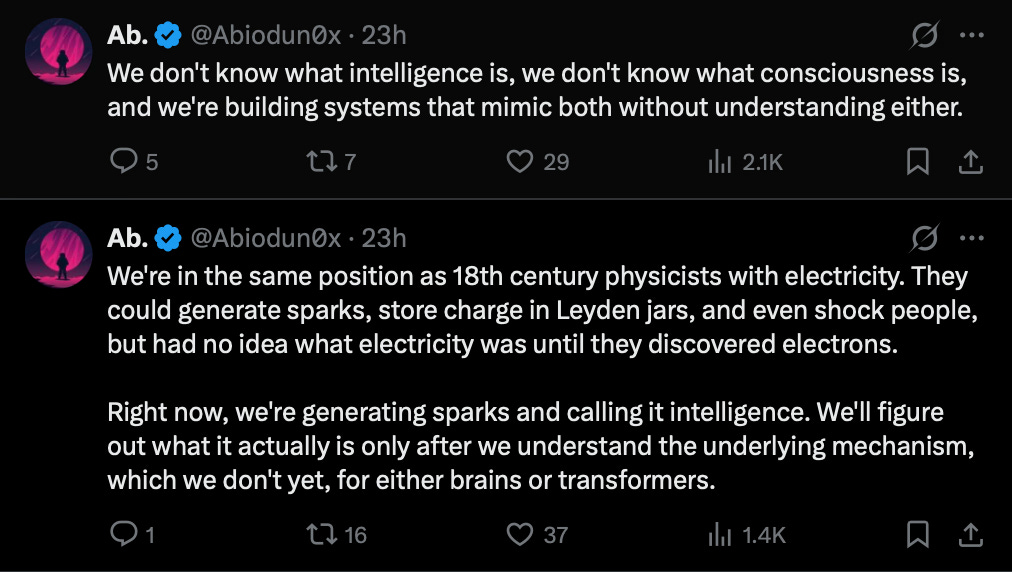
Then he reached for an old comparison. We are standing, he said, where the natural philosophers stood in the eighteenth century, when they could draw sparks from the sky and bottle lightning in a jar and make a dead frog’s leg kick on the table, and still could not have told you what electricity was. We are generating sparks, he wrote, and calling it intelligence.
He is right, and there is a clean pleasure in how right he is. For two centuries we did exactly this. Benjamin Franklin flew his kite in 1752; the electron was not named until 1897. In the hundred and forty-five years between, people lit lamps and sent telegrams and were, now and then, killed by a force whose nature no one could yet explain. They did not wait for the electron. They could not afford to. The current was already in the wires.
This is the part of the analogy I cannot stop turning over, because it points somewhere Ab. (twitter friend) did not go. The eighteenth century did not understand electricity. But it understood, very well, what electricity did. You did not need a theory of the electron to know the shock would burn you, or to learn the discipline of where to put your hands. The nature of the thing stayed a mystery for a century and a half. The effect of the thing was available to anyone who touched it.
We are having the wrong argument about artificial intelligence, or rather, we are having the luxurious one. Is it conscious. Is it truly intelligent or only pretending. Is it a mind or a very expensive autocomplete. These are beautiful questions and I do not think they are foolish. But they are the questions of people who have time. We will not settle what intelligence is before these machines have rearranged how a few hundred million people think, the same way the current ran in the wires long before anyone could say what moved through them. The metaphysics can wait. What the thing is doing to us cannot.
And it is doing something. I know this less as a theory than as a thing I watch, because I build a tool that people think with, and I spend my days at the seam where a person meets a machine that will, if asked, do their thinking for them. Here is what I have come to believe. There is a kind of work that looks like waste and is not. The slow, unpleasant labour of sitting with a hard page until it yields. The argument you have with yourself before you know what you believe. The sentence you write four times because the first three were lies you were telling yourself. A machine can spare you all of it now. It will hand you the summary, the position, the finished paragraph, warm and reasonable and yours for the taking. And every time you take it, something that would have grown does not.
We have a word for what happens to a muscle that is never asked to lift. We have not yet found the courage to use it for the mind. But anyone who has stopped doing their own arithmetic knows the feeling of reaching for a faculty and finding it gone soft. The danger of these machines is not that they will think for us badly. It is that they will think for us well enough that we stop noticing we have handed it over. The shock that kills is not the one that throws you across the room. It is the small steady current you learn to keep your hand on, because it is warm, and it asks nothing of you.
When I built my own small thing, I made a decision that, on paper, is bad business. I would not let it read the book for you, or give you “bite-sized learnings”, or promise to make you read faster, instead, it will talk with you about what you have read, argue with you, remember what you noticed, but it will not go and have the experience on your behalf and bring you back a souvenir. Someone told me this was a mistake, that people want the souvenir, think blinkist, think this and that. He is likely right about what people want. But I have come to think the whole game is hidden in the friction we are all racing to remove. The reading is not an obstacle standing in front of the understanding. The reading is the understanding. Take it away and you have a person holding a beautiful summary of a country they have never been to.
Now multiply one person by a continent. When hundreds of millions of us reach for the same few machines to perform the same acts of thought, we do not only lose something each, privately. We begin to think the same shape of thoughts, the way a river takes the shape of the channel cut for it. I come from a people who carried their knowing in proverbs, who taught judgement through stories told slowly by elders who were in no hurry. The proverb is a technology too. So is the book. So is the alphabet. But every technology of the mind we have built until now extended the thinking and left the thinking to us. This is the first one that offers to do it instead. That is not a small difference. That is the whole difference.
I am not telling you to put the thing down. The current is in the wires; that argument is finished. I am saying that the eighteenth century, which could not explain electricity, still learned the more important thing in time, which was respect. It learned where to put its hands. We will have to learn the same discipline far faster, and the discipline is this: to decide, on purpose, which thinking we will keep for ourselves. Not all of it. Let the machine hold the things that were never precious, the spellings and the schedules and the half-remembered addresses. But the hard pages, the slow arguments, the four drafts of the honest sentence. Those we keep. Not because we could not give them away. Because we have finally understood what the giving costs.
You see, my Twitter friend is right that we are generating sparks we do not understand. But you never needed to understand the spark. You needed to know it could light a room or burn it down, and to keep your wits about you in its company. The understanding can come later, the way it always has. The respect cannot wait. The old people had a saying, that the lizard who threw himself down from the high iroko tree said he would praise himself if no one else did. I think of it often now, building these things. We are all very busy praising the jump. It might be worth asking, while we are still in the air, where exactly we intend to land.
There was a paragraph you mentioned about preserving some thinking for ourselves and no truer words have been said. The introduction of these machines are understandably here to help make things easier but we really need to draw the line on the way we use it.
Again, nice read.
I really enjoyed reading this.